
https://triblive.com/local/valley-news-dispatch/newly-formed-alle-kiski-emergency-service-authority-could-become-model-for-failing-system/
Newly formed Alle-Kiski Emergency Service Authority could become model for failing system

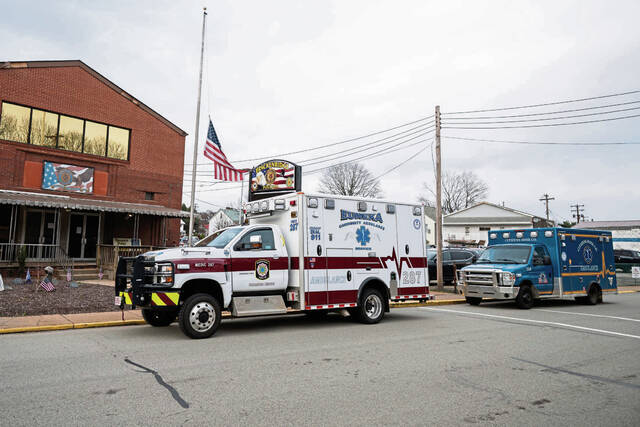
Pioneer Hose Chief Rick Jones believes that a newly formed paid EMS authority in Brackenridge, Harrison and Tarentum will be a game changer.
Jones, of Brackenridge, was named to the board of the Alle-Kiski Emergency Service Authority, approved Wednesday by the three municipalities.
Under the agreement, property owners will pay an annual service fee that leaders said will create a sustainable funding stream and alleviate worry over how to keep the doors open at Eureka Community Ambulance and Citizens Hose EMS. The two companies will merge this year.
The new service fee, tentatively set at $85 per property, will provide that funding.
“I’m eager to get this thing up and running,” Jones said. “One of my biggest hopes is that other communities want to join in.”
He believes the authority will serve as a model for other ambulance services across the A-K Valley, many of which are trying to combat fragmented funding sources to stay afloat.
“That’s why they named it Alle-Kiski, so there’s room to grow,” Jones said.
Substandard insurance reimbursements, combined with a declining number of volunteers and increasing equipment costs, have spurred a crisis for EMS locally and across the country.
The number of EMS agencies statewide dropped 23%, from 1,645 to 1,259, between 2013 and 2021, according to the Pennsylvania Fire and Emergency Services Institute.
Across the state, the number of EMS workers has plummeted because of low pay, competing interests and increased training requirements.
There were 50,000 certified personnel in Pennsylvania in 2020, down 60% from 1970, according to the state Department of Health.
Mergers and paid EMS authorities are thought to be a viable solution for failing traditional models.
Eric Schmidt, Shaler Hampton EMS chief and chair of Allegheny County EMS chiefs, said the time has come and gone for people to “bury their heads in the sand” about the dire EMS situation.
“I hope people pay a lot of attention to what is happening with the Alle-Kiski Emergency Service Authority,” Schmidt said. “You have Eureka and Citizens, both with 90-plus years of service, and they’re willing to walk away and create something new to save it.”
Schmidt, who spends much of his time educating municipal leaders about EMS sustainability, credited Harrison, Brackenridge and Tarentum for a progressive approach.
“There’s going to be more services failing, and these guys are making sure it doesn’t happen there,” he said.
Schmidt said ambulance services have to be prepared 24/7. The cost of readiness for Eureka and Citizens, including equipment, education and training, is about $2.4 million.
Schmidt also is rooting for proposed bipartisan legislation that would address several of the industry’s struggles.
House Bill 1152, proposed by state Rep. Jill Cooper, R-Murrysville, would require insurers to pay 350% of the current ambulance rate established by Medicare and Medicaid, and would apply only to state-mandated 911 calls.
The practice of requiring patients to pay the difference between the total cost of services and the amount the insurance company pays, commonly known as balance billing or “surprise billing,” would be prohibited.
“That would change everything,” Schmidt said. “We’re hopeful it will move forward.”
Ben Shopland, Foxwall EMS chief in Fox Chapel, said paid authorities won’t solve all the challenges of first responders but are crucial to ensure sustainable funding.
Shopland in recent months forged his own path to survival through what he calls a strategic partnership with West Deer EMS.
Primary coverage areas include Fox Chapel, Aspinwall, West Deer and Indiana Township. The new deal is meant to boost staff and equipment availability and provide better coverage.
Shopland said collaboration is essential for the future of EMS across the state. He believes the new authority could set an example.
“Every forward-thinking EMS service will be looking at ways to operate more efficiently without reducing the quality of care or the quantity of EMS resources available in the community,” he said. “Each borough or township having its own ambulance service results in a duplication of administrative functions and reserve equipment with very little capacity to handle surges in call volume.
“Leadership of the new Alle-Kiski Emergency Service Authority should be applauded for seeking solutions that promote efficiency, transparency and sustainability, all of which can be accomplished with an authority,” Shopland continued. “EMS is a community asset. There has been a lot of dialogue and community input, which I think will help them be successful.”
The authority could grow as early as next year.
Fawn, which is covered by Eureka, did not opt into the authority but will need to discuss ambulance service for 2027. It is required by state law to be provided for residents.
Township secretary/treasurer Pam Ponsart said the board did not feel comfortable making that kind of decision without definite information on costs.
“It’s something they’ll discuss throughout the remainder of this year,” she said. “It’s on our radar.”
Copyright ©2026— Trib Total Media, LLC (TribLIVE.com)